Monday, 2 May 2011

Unique Garden

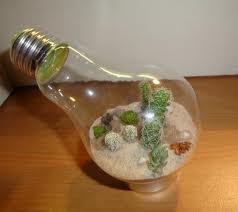
Truly unique! Miniature tropical rain forest, desert ecosystem, vegetable gardens and so forth is only possible with a terrarium.

Type of Terrarium Plants
Given the media glass terrarium is limited in size and has a unique biosphere, the selection of plants placed in the terrarium also be appropriate. Some plants commonly used in the terrarium, among others sansiviera, cactus, succulent and bromelia.


Three Category Terrarium:
1. Open Air Terrarium
Terrarium with the top open or closed. To create a miniature plants, such as the media is the most easy to use and maintain. You can even make decorative plants in a terrarium type this in a very short time.

 
2. Terrarium Closed
Terrarium with a sealed condition in all sections. The goal is to create a unique biosphere in the terrarium. Terrarium is the most difficult to be made and maintained. More challenges in making this type of terrarium. Some factors that must be special attention to a closed terrarium is a matter of quantity of water and proper lighting. Terrarium of this type usually have the top of a small to put plants and other material in the terrarium. Of course this can be a challenge.

 
3. Terrarium Animals
Terrarium this kind used to put small animals for display. For example, lizards, iguanas, frogs, small turtles or snakes. The goal is to display replica of the real world of fauna in the wild by moving it into an attractive glass media.


Sunday, 1 May 2011

Placement of Terrarium

Terrarium can be placed indoors for long periods without sunlight, by replacing sunlight with a special lamp. You can put the terrarium in the house, in a display shelf, in the office or gallery. This will add to the uniqueness of the decor and also add a collection of indoor plants.

Although it is easy, without a careful review of techniques and the media, terrarium can not last long. Without proper treatment techniques terrarium, the plants will languish because of damage to the water cycle.
Wash plants or soil with water when the media starts to look dry. Routinely done watering once every week or less if necessary. Cut leaves from damaged plants in a terrarium for a wonderful stay. The location of plants is also worth noting. Do not place in areas exposed to direct sunlight because it can make quick dry soil conditions.

Terrarium can be used for various needs, such as for research, methods of planting and decorating.

Terrarium Maintenance

Before display, save the first terrarium 2-3 days in the shade for plants can adapt and put the terrarium at room temperature.

If in place of air-conditioned, terrarium should be watered more often, because air conditioning made ​​the room become dry. Do not let the terrarium in direct sunlight, because the terrarium can also grow with the help of fluorescent lights.

Do not forget the watering process. Watering is done by mouth pressed glass of water on the walls of the container and pour it slowly. In this way, watering will not damage the beauty of the terrarium. In normal circumstances, the terrarium can be watered once a month.

Watering depends on the type of plants and terrarium conditions. Importantly, the terrarium must be kept moisture but do not get flooded. Zeolites can also be an indicator of lower humidity. If the zeolite change color to white means your terrarium in the dry state.

Do not forget the watering process. Watering is done by mouth pressed glass of water on the walls of the container and pour it slowly. In this way, watering will not damage the beauty of the terrarium. In normal circumstances, the terrarium can be watered once a month.

Watering depends on the type of plants and terrarium conditions. Importantly, the terrarium must be kept moisture but do not get flooded. Zeolites can also be an indicator of lower humidity. If the zeolite change color to white means your terrarium in the dry state.

Very easy. Limited land can never handcuff your hobby farming-planting, because terrarium can be a solution. Terrarium container in the form of the jar or bottle of clear glass is a miniature ecosystem is very healthy.

Hobby of ornamental plants is indeed not necessarily have to have a large area. Interestingly, the terrarium can be placed anywhere according to your wishes

How to create a Terrarium easily


As a first step, the first one done is the creation of media.
Make a layer of media with formation of a layer of gravel or zeolite, the size of gravel at the bottom, then flatten spagnum moss on the gravel, then flatten zeolite on moss. Give also a layer of rice husk on top of zeolite. Lastly, sprinkle with ground zeolite or compost on top of charcoal husk.
Make a contoured surface in accordance with your creativity. Media volume is 1 / 3 or 1 / 5 of the container volume. For the high container, use the funnel as a tool.


Then a second process, which is also quite important, is to enter the plant. Before you start putting, you should first design the layout of plants in the terrarium. Instead, do not mix plants of different nature in a terrarium.

After that, clean the plant roots. If the roots are too long, cut a maximum of 1 / 3 the volume of the root. In restructuring the terrarium, start from a plant whose roots are the longest. Close the back roots with zeolite. After laying out the plants, wet the plants with a spray of water to maintain freshness.

It was time to decorate your terrarium. Accessories that can be used are sand bali, coral, pine fruits, shells and so forth. After decorating, clean glass container terrarium with gauze. For hard to reach areas, use chopsticks wrapped in gauze-tipped.

Preparations to Create Terrarium


Although it is easy, without a careful review of techniques and media, terrarium can not survive for a long time. Without proper treatment techniques terrarium, the plants will languish because of damage to the water cycle. So the first step to create a terrarium
1. Prepare a planting medium and material for decorations like ~ glass media (such as aquarium fish, small, large glass bowls, glass boxes, glass bottles or jars), zeolite sand, soil humus, spagnum moss, charcoal, rocks and sand.
2. Prepare all equipment that will be used to create a miniature garden in a terrarium like ~ Scope mini or spoon, Tweezers (Pin Set) or chopsticks, scissors, a plastic funnel or a funnel made ​​of paper, Iron plant (sprayer), watering kettle, mesh fabrics, brushes.